
Nominal Returns
The quietest line in the March print just made the loudest case

Good morning,
As promised this a reflection piece. Sometimes it takes a year or even lponger to see developemt of a core thesis, ad sometimes it develops in weeks. We are living through the latter. We are writing this fresh from a few days in Beijing where the streets are alive in the way they used to be before the long deflationary stretch took the air out of the place. Sanlitun on a Saturday night was three-deep at the bar; the queues outside the new tea-and-pastry concepts were 40 minutes long; the foot traffic in Wangfujing and Xidan looked like a normal year, not a recession year. Restaurants are excellent and cheap. Hotels are excellent and cheap (you notice the trend). Commerce is happening on every corner: courier scooters bumping at every traffic light, the subway packed at off-peak hours, every shopper on her phone in front of every shelf. The lived experience of the place and the headlines about it have rarely been further apart.
Two months ago, in The Quality Turn: Thoughts on the NPC, we made a a side point hidden inside a long piece about a five-year plan. The most important macro number for Chinese equities in 2026 was not real GDP, retail sales, or credit aggregates. It was monthly PPI. As factory-gate prices stop falling, revenue grows faster than input costs across most of industrial China, and that operating leverage flows directly into corporate margins. We had PPI averaging minus one percent across 2026, with a return to near-zero only by the fourth quarter. We said: watch this monthly.
It turned in March. Plus 0.5% year-on-year, the first positive print since June 2023, three quarters earlier than the trajectory we wrote two months ago. It sat in the margin of an NBS data release that the wires picked up briefly and moved on from, because it landed alongside a 5.0% real GDP figure that beat consensus by twenty basis points and mattered to the equity market for an afternoon. Almost everyone we read filed PPI under “noisy commodity passthrough, mostly oil” and went back to debating whether 4.5% or 5.5% would be the floor for the GDP target in 2027.
That is fine. The market often takes a quarter or two to notice when a macro variable has changed regime, and the gap between the print and the consensus position is where most of the alpha lives. So this is the piece where we say what the print means, hold our December outlook and our March follow-up to account, and draw the line between the parts of the playbook that are working and the parts that are not. We promised in March we would do this every quarter. This is the first one.
Short version: the eight themes from December are working, the five Quality Turn implications are biting on schedule or earlier, and the print that did the heaviest lifting in 1Q26 is the one nobody quoted. The pieces still stuck are exactly the pieces we said would be stuck, plus two we want to flag explicitly. The question now is, what comes next. Beijing is conserving optionality, rather than spending all up front. That is the right answer for where we are in the cycle, even if it is not the answer that produces the most noise at this point in time.
IMPORTANT NOTE: We are presently in the process of getting a license with a major regulator, and while that process is ongoing we are not able to publish the portfolio update and company notes. We’ll do a big reveal of the new plans as soon as we’re in a position to do thusly. We apologise for it taking time, but this is unfortunately a fact of life. With that we’re also putting the opinion part of this behind the wall.
NOTE: Panda+ is now closed to new joiners. We thank everyone for their interest and custom.
Nothing in this Substack is Investment Advice. This information is provided for informational purposes only and does not constitute financial, investment, or other advice. Any examples used are for illustrative purposes only and do not reflect actual recommendations. Please consult a licensed financial advisor or conduct your own research before making any investment decisions. The authors, publishers, and affiliates of this content do not guarantee the accuracy, completeness, or suitability of the information and are not responsible for any losses, damages, or actions taken based on this information. Past performance is not indicative of future results.
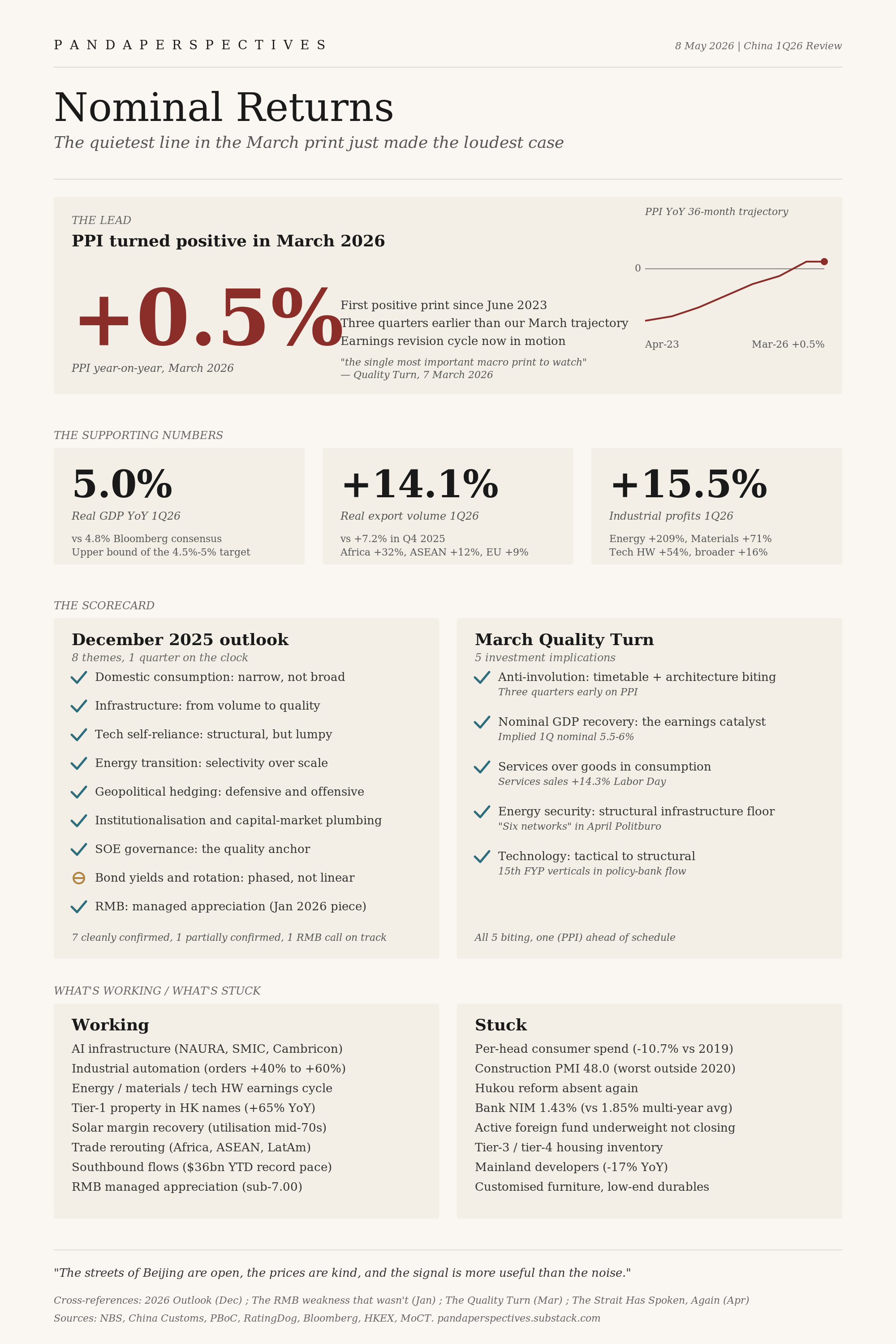
PPI in March was plus 0.5% year-on-year. Small number, big change: the first positive monthly PPI reading since June 2023, ending a 33-month deflationary stretch that took the index roughly four percent below its prior peak and earned China the only sustained industrial-deflation regime among major economies since the global financial crisis. April will print in mid-May at a slight further uptick on base effects and continued anti-involution discipline. The trajectory matters more than the level: the slope from minus 2.4% in October 2025 to plus 0.5% in March 2026 is a regime change in motion.
The Quality Turn forecast had PPI averaging around minus 1% across all of 2026, with our explicit comment that “a PPI recovery that arrives ahead of the current timeline would be the most significant positive catalyst for earnings revisions.” It has arrived ahead of timeline. We were wrong on the speed and right on the importance. We underestimated how quickly the supply-side discipline written into the 15th Five-Year Plan would translate into pricing.
The mechanism is straightforward. When PPI is falling and input costs are flat or rising, revenue per unit declines while costs per unit do not, and operating leverage works in the wrong direction. When PPI turns positive while input costs are managed by anti-involution discipline, the same operating leverage works in the right direction. Industrial profits move higher than the volume of activity suggests they should, margins expand, and consensus earnings estimates need to be revised up to keep pace.
Early evidence in the 1Q26 prints: energy sector earnings rose 209% year-on-year, materials 71%, tech hardware 54%. Industrial profits across the broader universe rose 15.5%, with March accelerating to 15.8%. The All-China universe of reporters as of early May was up 16% in aggregate on revenue growth that was substantially smaller. That is operating leverage, and that is the cycle the Quality Turn argued was the real story.
